
Leveling Up
New Art World Order | The Coordination Game

by Rachael Lambert
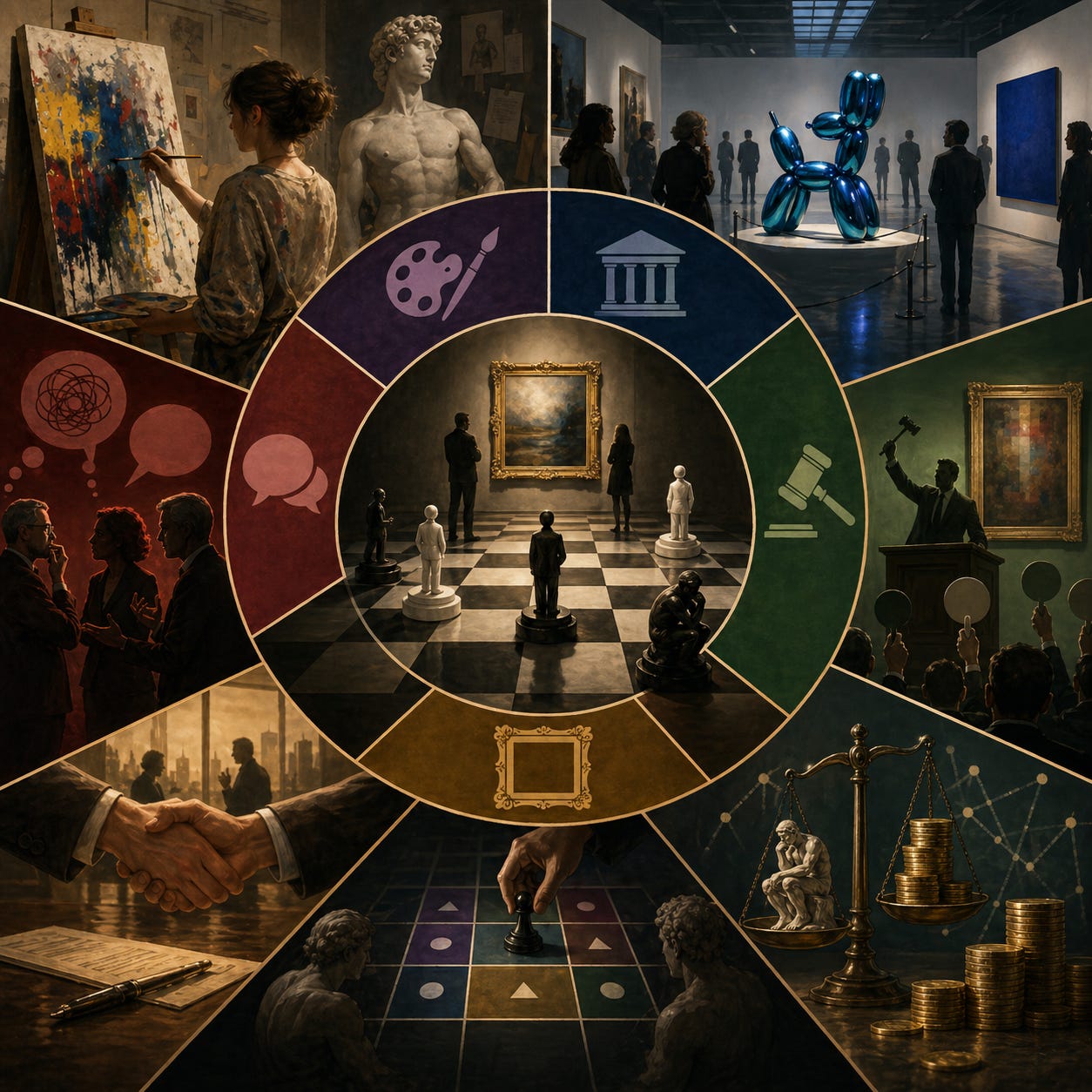
There is one constant to working in the arts that makes it deeply thrilling and tear-your-hair-out frustrating. That constant is change.
Contemporary art by its very nature is at the precipice of the future. For the people who work in it, it is a constant game of pivoting, problem-solving, and strategizing. At its very best it is to be part of something much bigger than yourself, to facilitate change in the world, to actively participate in history. At its very lowest it is a deeply thankless and isolating experience. It’s only art, after all.
There is a particular kind of freedom that lives at the beginning of any creative endeavor before the industry gets its hands on it, before the game becomes legible, before you know enough to worry. Most people who stay in this world long enough eventually trade that freedom for something harder and more durable. The lesson of control. The illusion that we have it.
I told you I was done writing publicly about game theory. I meant it at the time. But the game changed, through playing well I was able to level up, and when the game changes, the analysis has to follow. The moves available to me are different now. And so, in alignment with my bleeding heart, here we are again.
Game theory, for the uninitiated, is simply the study of how rational players make decisions when the outcome depends not just on what they do but on what everyone else does too.
If you’ve been following along, you already know my position on zero-sum thinking in this industry, that the dealer-artist relationship, when it works, creates value neither party could generate alone. Today I want to go one level deeper. Because zero-sum versus non-zero-sum is only half the map. The question that follows is this: once you’ve accepted that the game isn’t zero-sum, how do you actually win it?
The answer is coordination. And coordination has its own rules.
Something is shifting in how value moves through creative economies. Not just in art, everywhere. The research coming out of brand strategy, creator economics, and enterprise consulting is pointing in the same direction, using different language to describe the same phenomenon. McKinsey calls it the rise of intangible assets. Brand strategists call it the trust economy. What they are both observing is that attention has become cheap and abundant while trust has become scarce and difficult to manufacture.
The data is consistent across industries. Pew Research Center has documented sustained declines in institutional trust, in media, in platforms, in expertise, over the last decade. At the same time trust in individual voices and peer recommendation is rising. People are not becoming less trusting. They are redirecting trust away from institutions and toward people. SignalFire has tracked a steady decline in median creator earnings even as the total number of creators and total content volume explodes. The top percentile earns more. Everyone else competes for scraps. Which means effort is no longer correlated with outcome and when effort stops predicting outcome, people don’t just get discouraged. They lose the psychological framework that makes sustained work possible at all. This is not a motivation problem. It is a signals problem.
The signals are broken at the platform level too. Engagement rates on Instagram, TikTok, and across major platforms have declined even for accounts with consistent posting and strong work. Growth is increasingly pay-to-play or personality-led rather than craft-led. People are doing exactly what they were told to do and it is no longer working. That is not a personal failure. It is what happens when a system stops working and nobody announces it. The map has expired. Most people just haven’t been told yet.
And so they are simplifying. Behavioral economics research is consistent on this: as choice increases, satisfaction decreases, decision delay increases, and default-to-trust behavior increases. People are not exploring more widely in conditions of overload. They are contracting toward the voices they already trust. Collectors rely more on advisors. Readers follow fewer Substacks more deeply. Buyers ask who do you trust more than what should I buy. That is not confusion. It is defensive clarity, a rational response to a system sending too many signals at once.
The surface language of this industry, the fair circuit, the auction records, the press placements, the Instagram metrics, is the language of competitive games. Speed. Volume. Visibility. The spike. And artists, dealers, and collectors internalize that language and begin to believe it describes the actual game. It doesn’t. Underneath all of it, the art world has always been a coordination game. The same collectors, dealers, artists, and institutions interacting over decades. Reputation persisting long after the press release fades. Relationships surviving market cycles that flatten everyone who was only playing for the quarter.
The 2025 numbers make this visible in a way that is hard to ignore. The average number of unique buyers per dealer fell to 57, the lowest since 2021. The broad market contracted. And yet galleries with annual turnover under $250,000 grew sales by 17 percent. The smallest operators, the ones most dependent on genuine relationships rather than institutional momentum, held while the middle compressed and the top retracted. That is not a coincidence.
The people who built lasting programs in this industry understood this intuitively even when they couldn’t name it. They were not the loudest. They were the most legible. You encountered their program and immediately understood what they stood for, who they were for, and whether you belonged in that room. That legibility is what makes coordination possible. It is what gives collectors, artists, and institutions a reason to come back.
Economic uncertainty has a clarifying effect on coordination games. When resources tighten and attention fragments, the players who survive are not necessarily the best resourced. They are the most trusted. Uncertainty strips away the arrangements that were performing coordination while actually running on competitive logic, the galleries collecting artists the way others collect followers, the advisors whose value lived entirely in access rather than judgment, the collectors buying momentum rather than conviction.
Robert Axelrod’s tournament research in the 1980s demonstrated that in repeated games, games played over time with the same players, the simplest cooperative strategy outperformed every sophisticated competitive one. Not because cooperation is morally superior. Because in a game with memory, defection is eventually punished and cooperation compounds. The prisoner’s dilemma assumes a single interaction. The coordination game assumes a lifetime of them. That one shift changes everything about which strategy wins and the art market, with its decades-long relationships and long institutional memory, has always been the latter whether it admitted it or not.
The Art Basel and UBS report puts a number on what that memory looks like in practice: 31 percent of dealers identified art fairs as their primary source for new buyers. Which means even the most productive single investment a dealer makes produces not a sale but an introduction. The fair is the opening move. Everything that follows, the follow up, the relationship, the eventual transaction that might arrive four to nine months later, lives entirely in the relational architecture built after that first encounter. You cannot hack that timeline. You can only tend it.
There is a counterforce worth naming. Game theorists call it the Nash equilibrium, the stable state where no player can improve their position by changing strategy alone, even when the collective outcome is bad for everyone. It is why broken industry norms persist long after everyone privately agrees they are broken. Every dealer knows the group show model often exploits artists. Every artist knows chasing fair placement can hollow out a practice. Every collector knows buying on hype is a losing long game. And yet the behavior continues because unilaterally doing something different feels like unilateral exposure. The Nash trap is not ignorance. It is the rational response to a system where the first person to move differently absorbs all the risk while everyone else waits to see what happens. This is why coordination requires legibility. Someone has to make their point of view clear enough that others can orient around it without feeling like they are stepping off a cliff alone. The program that stands for something specific is not just an aesthetic choice. It is a coordination mechanism. It gives other players a stable point to move toward.
We are between equilibria. The old stable strategy, chase attention, optimize for visibility, move fast, is visibly breaking down. The new one hasn’t fully revealed itself yet. But it’s forming. You can see it in the data, in the behavior of the smallest operators who are growing while the middle compresses, in the collectors who are asking different questions than they were three years ago. Some players are still running the old playbook, defecting toward attention and short-term extraction. Others are quietly building the trust-based networks that will define the next stable state. The players who understand which game they’re actually in right now, before the new equilibrium settles, are the ones who will have shaped it by the time everyone else catches up.
The window for being first is always shorter than it appears. Early in any program, the terms are more open, the relationships more formative, the access more direct. That is not generosity for its own sake, it is the structure of how coordination games build. The early players shape the room. As the program matures, the room fills, the terms reflect that, and the nature of what’s on offer changes. This is not a threat. It is just how gardens work. The best time to be in one is always while it is still being planted.
The collector who takes three years to buy is not a failed relationship. The artist who needs two years of development before their market coheres is not a liability. The program built around six artists over a decade is not a small program, it is a deeply leveraged one, if the relationships are genuine and the point of view is clear.
Taste, real taste, functions as a filter rather than a broadcast. And filters, in a saturated market, are the scarcest thing there is. Everyone has a platform. Very few people have a room that the right people actually want to be in.
The game has always been about that room. Who is in it. Who gets invited back. Who tells someone else it’s worth their time.
Access has become the art world’s most overused word and its least examined one. What people mean when they say they want access is almost never what they think they mean. They do not want the door opened to a room they do not yet have the language to navigate. What they want, what they are actually asking for, is an end to the feeling of being looked through. To elitism. To the particular cruelty of a world that performs openness while hoarding orientation.
Those are not the same problem and they do not have the same solution.
Lowering the price of entry is not access. Putting works under five thousand dollars on a wall is not access. An open fair, a public museum, a free Instagram account, none of these things give someone the map. They give them the territory without the legend. And a territory without a legend is not freedom. It is just a more democratic version of being lost.
Real access is orientation. It is understanding how the game is structured, what the rules are at each level, what it costs to participate seriously, and what the difference is between being a visitor to this world, a maker inside it, or someone building the infrastructure that holds it together. That knowledge has never been priced. It has been distributed through proximity, through who you know, who taught you, which rooms you were allowed to sit in long enough to absorb what was never said out loud.
The coordination game reframes this entirely. In a trust-based system, orientation is not a luxury reserved for insiders. It is the product. The dealer who explains how the market actually works is not giving something away. They are building the kind of relationship that compounds. The collector who understands what they are buying and why does not need to be managed. They become a genuine participant in something larger than a transaction.
That is not elitism in reverse. That is what access actually looks like when someone builds it honestly.
Lion & Lamb Contemporary opens to the public this month. I built it for the people who read to the end.
xoxo
-Rachael