
THE SEAM
New Art World Order | The death of the honor system

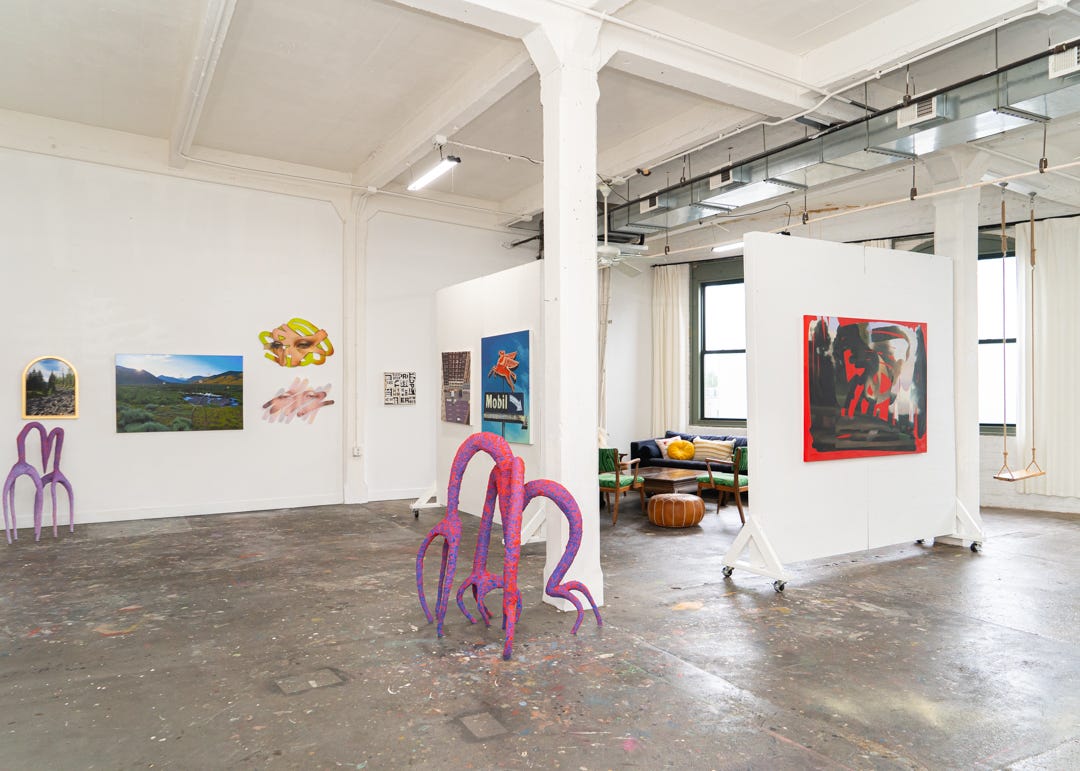
The Shape Of Things, Now on View. Email info@lionandlamb.art to inquire.
by Rachael Lambert
Well, it finally happened, sooner than expected. I’m writing this 24 hours before my first show in the new space here in Philadelphia. The timing seems cosmic.
Not the AI part. I’ve been writing about that since 2024. The part where an argument you built carefully, over years, shows up somewhere else, unattributed, dressed for sale. A workbook. Diagnostics. The whole apparatus.
I won’t relitigate what happened this week. Short version: I recognized my own thinking somewhere I hadn’t put it. Not word for word, the bones were unmistakable. I raised it. The response was measured, unfalsifiable, and ended in a block. I’m not interested in making this about one account. What’s interesting is the question it left me with: how do you even tell anymore? Does it matter?
Roughly three out of four newly published web pages now contain AI-generated content. 74.2%, by the most cited count. Content marketing specifically runs closer to 78%. Most of it is a blend, a person prompting, shaping, publishing, but the blend is the default now. Two years ago this was a novelty. Now it’s the water.
Art has been slower. Galleries use AI heavily for press releases, emails, translation, the unglamorous stuff, while collector appetite for AI as an artistic medium stays cold. Most galleries say it rarely even comes up with collectors. So the fault line isn’t “will AI make the art.” It’s that the writing about art, the analysis, the market commentary, the thinking that used to be the credential, is running at the same rate as everything else on the internet, in an industry with no infrastructure for telling the difference.
For most of this industry’s history, sounding like you knew what you were talking about required actually knowing. Now it doesn’t. The barrier between having the knowledge and performing it has never been thinner.
Transformative use is the doctrine that lets culture build on itself. Collage, sampling, appropriation art, all of it depends on taking something and doing something meaningfully new with it. The canonical case is Cariou v. Prince: Richard Prince altered and recontextualized another photographer’s images, and a court found much of it transformative enough to be fair use. Controversial, because it asked a judge to decide how much change is enough, case by case, image by image.
Prince made a deliberate choice about a specific photograph. An AI model ingests millions of images or a lifetime of essays and outputs something that may or may not resemble any one of them closely enough to matter, and the person prompting it usually has no way of knowing which sources shaped what came out. Transformative use assumed a human making a legible choice about a specific source. What happens when the choice can’t be traced at all, and the person publishing the output isn’t lying when they say they don’t know?
The early rulings cut in different directions. A federal judge found training Anthropic’s models on legally acquired books “spectacularly transformative”, fair use, while ruling that keeping pirated copies wasn’t; the case settled for $1.5 billion. A parallel case against Meta reached a similar result days later, by a different route, with the judge pointedly rejecting the idea that transformativeness alone settles anything. A case brought by Thomson Reuters went the other way entirely: a legal research tool trained on Westlaw was ruled not transformative, because it competed directly with the product it learned from. A class action from visual artists against Stability AI, Midjourney, and DeviantArt, arguing that outputs “in the style of” a named artist are unauthorized derivatives, is still in discovery, years in, with no ruling on whether style itself can be infringed.
No consensus. The doctrine that resolved one Richard Prince painting at a time is now asked to resolve billions of outputs at once, generated by systems whose relationship to any single source is unknowable even to the person who typed the prompt.
Here’s the part that worries me.
Cariou worked as doctrine because there was one defendant, one photograph, one judge making a human call about degree. That system assumes scarcity, a person can only appropriate so much in a career, one traceable decision at a time. AI removes the scarcity. “Transformative enough” now gets answered across an entire training corpus, millions of times, automatically, and often nobody, including the company running the model, can say which works shaped which output. Prince knew exactly whose photograph he cut up. Nobody running a diffusion model can say the same. That’s not a difference of degree. It’s a difference of kind, and the law hasn’t caught up.
Notice who that protects. Every major ruling so far has cleared the training step on transformative-use grounds, while drawing the line somewhere narrower and easier to police, what a company kept on a server, not what happened to any individual artist’s work once it went in. Good architecture for protecting the people building the models. Nothing in it gives one artist a way to point at a specific harm and get paid for it.
Here’s what would: artists cut into resale the way any other asset owner is, and their work trademarked the way an invention is patented. A patent gives an inventor a claim on derivative use for years after the fact. A painting or a body of work gets none of that. Both fixes exist in law already, just not for this. Neither is complicated. Neither has happened.
Two separate injuries live under this, worth keeping apart. Resale royalties, an artist seeing a cut when their own work resells for a fortune, aren’t an AI problem. The U.S. has never had one federally. An estate gets zero percent when a canvas resells for tens of millions, no model required.
And the resales keep getting bigger. Sotheby’s, Christie’s, and Phillips combined did $6.8 billion in six months, the best first half since 2022. JPMorgan posted the highest profit in its history the same quarter. None of it touches the artist, or the galleries that built the market for them. It’s even reaching backward now, Old Masters, the driest corner of the market, just pulled in a wave of new buyers, a fifth of Sotheby’s evening-sale bidders had never bought there before. Not tech’s NFT money finding a new costume. Flight to certainty: when everything else is unstable, four-hundred-year-old provenance rooted in scarcity starts to look like the safest asset in the room.
AI is the second channel. Same extraction, different mechanism. The auction house at least leaves a paper trail: a hammer price, a lot number, a name on the invoice who profited and by how much. A model trained on a lifetime of work leaves none of that. The value still moves, still gets extracted at scale, but there’s no ledger entry that says whose it was first.
One is an old failure, decades of case law and one failed statute, everyone can name the villain. The other wears it better: no single decision to point to, no one person who chose to take anything, just a system nobody fully understands producing outputs nobody can fully trace. Old failure, new failure, same artist standing outside the building the money moved into.
That building has a door I know personally. People borrowing credentials they haven’t earned to sell something. Artists lifting from other artists and calling it influence. The ones who actually built the thing standing off to the side while someone else takes the bow and the check. Multiply that by however many rooms it’s happening in, and you start to understand where the money at the top is really coming from. Not innovation. Consolidation, dressed up as something else, happening in plain sight because nobody’s built the infrastructure to catch it.
I don’t think every AI-assisted post is an infringement, or every resemblance a coincidence. I think the honor system that held this industry together, reputation, credentials, sounding like you knew the market because you probably did, doesn’t have anywhere left to stand. Scary isn’t the appropriation. It’s the untraceability, arriving exactly when the law protecting artists still assumes everything can be traced.
Provably human, provably curated. Where the industry is going regardless if it has named it yet or not.
Technology raises the floor faster than it widens the ceiling. The average American is better off than a nineteenth-century industrialist in medicine, food safety, information access. But each wave creates new axes of advantage, and money maps onto them faster than institutions build guardrails. Not that the average person loses ground, that the distance between top and bottom gets measured in things money never used to buy: attention, health, time.
Art is where this always shows up first, because art isn't a market for objects. It's a market for scarce, authentic human decision-making. Every new technology makes that decision-making either more replicable or more purchasable, and the art market's job is figuring out, in real time, what's still irreplaceably human once that happens. That's the core of what Lion & Lamb is built to be: the answer to a question the market hasn't had to ask before now. What a human-made object is worth to other humans. What a gallery is for at all.
Starting next week, some of this writing moves behind a paid tier. A decision that was coming regardless, made sooner because this week made the reasoning obvious. If credibility can be manufactured at the same rate as everything else on the internet, a credible, accountable read on this market is worth more, not less. If you want to stay inside the velvet rope, become a paid subscriber.
Artists and collectors shouldn’t have to run this diagnostic alone. Not a failure of expertise, just not the job they signed up for. I said as much in January. Nothing about the last two weeks has made me want to take it back.
The Shape of Things is on view now through September 1st, twelve artists, one room, no diagnostic required to walk in and look. The Salon is where I’ll go deep on the artists in this show specifically: what each is doing, why it’s in this room and not another, what I’m watching for as the season plays out. That is also Paid-tier territory, starting with the next New Art World Order, the first piece behind the velvet rope here on Substack.
Next week The Collector Experience opens for beta testing, a different kind of room, built for collectors who want more than a mailing list. And a passion project I’ve been building quietly gets its first reveal, to the Salon, before anyone else sees it.
If you’d like to see what I’m up to, come see for yourself.
Thank you for reading
-Rachael