
The Succession Problem
New Art World Order | On who can afford to stay

by Rachael Lambert
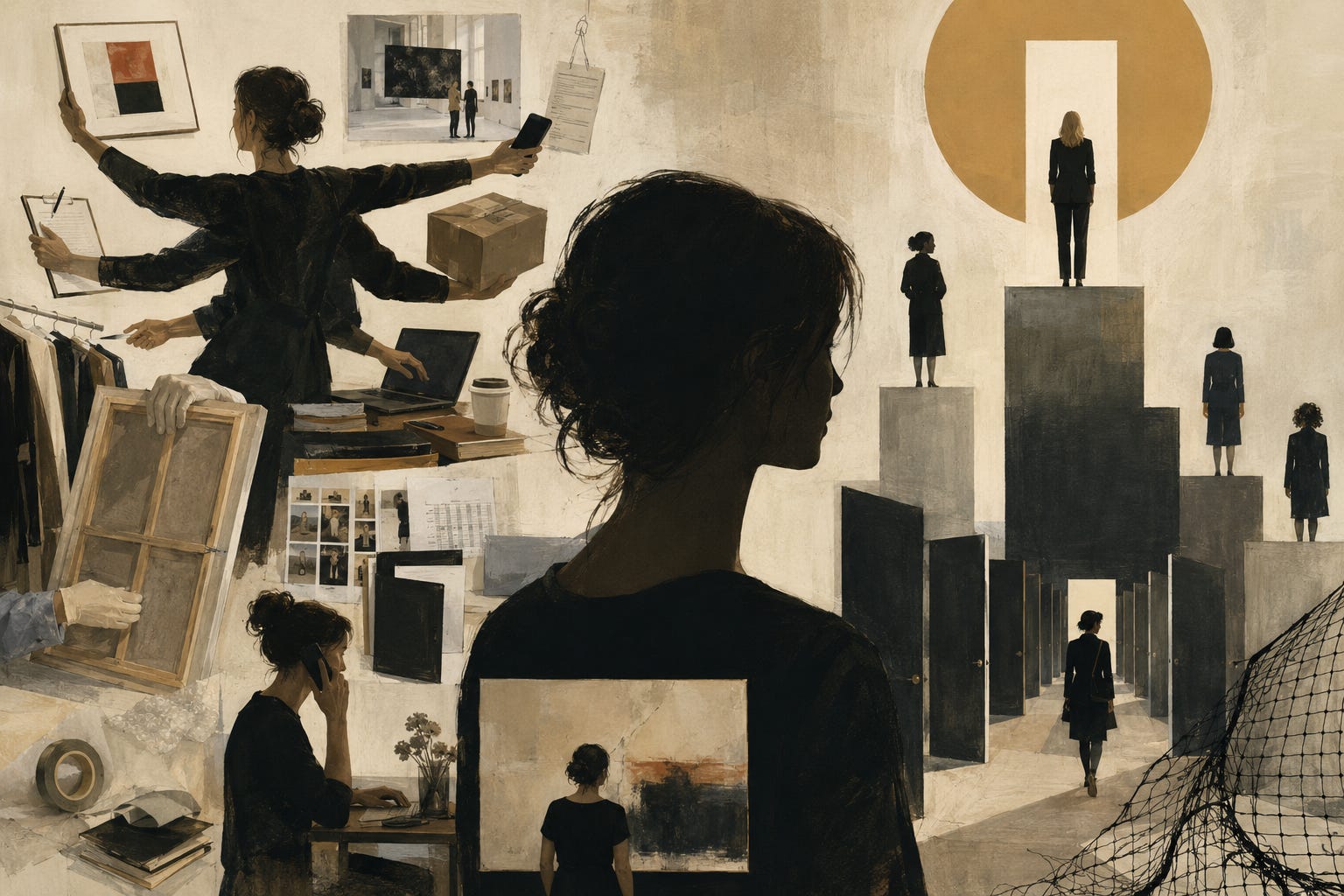
I opened my laptop this morning and read: “Nearly Half of Mid-Career Women Are Thinking of Leaving the Art World.” My heart. I am a mid-career woman in the arts.
This is not a new story.
Berthe Weill launched the School of Paris. Peggy Guggenheim built Abstract Expressionism. Virginia Dwan created the conditions for Minimalism and Land Art. Betty Parsons opened her gallery in 1946 and was the only dealer willing to represent Jackson Pollock when every other door was closed. As Helen Frankenthaler put it: “Betty and her gallery helped construct the center of the art world.”¹
Look behind the curtain of any major artist career or movement of the twentieth century and you will find a woman stage-managing the publicity, the exhibition design, the sales, the catalogues, the relationships. Women did not enter the art world. They built it.²
The present looks the same. Women earn 70% of fine arts bachelor’s degrees and up to 75% of MFAs. They make up the majority of professional museum staff. They manage galleries, run programs, build collections, write the wall text, handle the logistics, maintain the relationships, often for decades. On the buying side, high-net-worth women outspent men on art by 46% in 2024.
And they hold 30% of museum directorships. And they earn 75 cents for every dollar their male counterparts make in equivalent roles. As Marian Goodman said when asked if much has changed: “Men are more impressed by men than by women, when it comes right down to it.”³
The new Artnet/AWITA report, Hardwiring Change: Buying Back Time, confirms what anyone working in this industry already knows: the art world is run primarily by women who are simply not the majority holders of the presidencies, the directorships, or any institutional C-suite.
What is new is that the women running everything are now leaving.
50.6% of women aged 35 to 44 are considering leaving the arts within the next five years. The cohort that should be moving into leadership. The people who know how everything works and why. That is not the most important number.
64.3%. Mothers aged 25 to 34, the single highest figure in the entire report. The caregiving penalty landing at exactly the moment when careers need to be built, reputations established, and relationships cemented. The report notes it in a single sentence and moves on. 57.6% of women aged 35 to 44 without children. Which means this is not a caregiving story, or not only one.
53% of survey respondents hold master’s degrees. 46% have more than 20 years of experience. The industry’s most credentialed, most experienced workers and half of them are looking for the exit.
Nonprofit arts organizations lead attrition at 53.3%. The commercial art market, galleries, dealers, advisors, comes in at 49.2%. This is not a museum problem. It is an industry problem.
Large organizations, 100+ staff: 24.3% considering leaving. Mid-sized, 21–100 staff: 52.2%. Small, under 20: 49%. The art world operates almost entirely in small and mid-sized structures.
48% of full-time arts workers spend more than half their working time on administrative or logistical tasks. Nearly three quarters spend at least a quarter of their time on admin.
The administrative burden of working in the arts is not paperwork alongside the real job. It is catalog building, contract management, shipping coordination, insurance documentation, condition reporting, collector communication, artist communication, grant writing, social media, press outreach, website maintenance, invoicing, contract negotiations, vendor and building management, installation logistics, wall text, artist pages, exhibition records. It is the work that makes the work possible, and it is invisible.
This work has no off switch. These relationships do not end at 6pm. They text you. They call you on weekends.They remember you at openings, at dinners, at fairs, on the street, across years and decades. The arts is a relationship industry, and relationships do not clock out. It is also a global one, those calls, emails and texts come from different time zones on someone else's clock all day and all night.
The compensation does not reflect it. 71.5% of those considering leaving cite lack of recognition or adequate compensation. 62.9% cite broader financial instability. One respondent put it plainly: “Cost of living in the area, no overtime, no benefits, financially, I cannot grow my personal life by continuing my professional life in this capacity.” This is something I have said to myself before.
The skills required, sales, relationship management, portfolio management, crisis response, editorial judgment, logistics at scale, command multiples in any adjacent industry. In finance, relationship management is a defined role with a defined compensation structure. In medicine, the acute pressure of high-stakes decisions is bounded by shifts, rotations, hierarchies that distribute responsibility. In the arts, all of it lands on the same person, often without institutional support, often in an organization of fewer than five people, always without a guarantee that next month looks anything like this one.
A seasoned female gallerist once told me: every month you start from zero. It is also the kind of precarity the industry has normalized so thoroughly that pointing it out still reads, in some rooms, as complaint.
The low pay, the precarity, the administrative overload, the absence of any boundary between work and life, none of it is unbearable if something is underneath you. Family money. A partner’s income. Savings that can absorb a slow month, or three. The ability to start from zero every month only works as a business model if zero is not actually zero for you personally. And the broader economic instability makes that calculus more frightening than it was three years ago.
The art world has built an economic structure that is, whether by design or by default, a class filter. It selects for people who do not need the income to be reliable. And then it wonders why the rooms keep looking the same.
Nearly two thirds of arts workers are using AI tools in their daily work. 67.3% received no instruction on how to use them. Only 4.8% received any formal training. Workers are self-teaching, on their own time, tools their organizations neither provided nor supported to absorb workloads their organizations created and will not staff adequately. When asked where AI could be most useful, 57.2% said administrative tasks. Creative applications: 11.8%. This is not a creative revolution. This is individuals subsidizing institutional failure with their own labor and their own learning curve.
One respondent named it directly: “I don’t really want to use AI but feel I have to in order to get work done. It creates the illusion that I have more capacity than I do. I’m now using AI to do work I should have been paid for in the first place. The expectation of doing less doesn’t go away with AI. I think it’s making that expectation worse.”
If I were offered a well-compensated role with defined hours in something interesting and challenging tomorrow, I would take it. And I would keep building what I am building, because I believe in it. That tells you something about the economic reality of this work and about who can sustain it without that offer ever arriving.
The women who are leaving are not leaving because they lack passion. They ran the math. They looked at what their skills command in fields with defined roles, distributed pressure, and the ability to leave work at work. The industry has confused passion with subsidy for long enough.
The barriers stack.
76% of women aged 35 to 54 report facing structural barriers linked to gender, race, or class. For women of color, that figure rises to 80.8%, compared to 68.7% of white women. For Black women specifically, it reaches 89.3%, the highest of any group, and every single one of those respondents cited race as a factor. Black women and Asian women are the only groups in which race surpasses gender as the primary barrier.
Among women of color, 65.5% cite class as a structural barrier, compared to 39.6% across all respondents. The class filter is not neutral. It lands hardest on the people already navigating the most barriers.
The art world is simultaneously losing its most experienced workers and its most diverse ones. They are the same crisis operating through the same mechanism, a structure that rewards those who can absorb its costs, and those costs are not distributed equally.
The survey skews 74% white and toward respondents who have already stayed. The people most affected are the least represented in this data. The findings, already striking, are conservative.
The quote that has stayed with me: “In the beginning I felt, ‘fuck it, I will go far and change this shit.’ Now I am more, ‘maybe I should just do something else.’”
That is a rational response to a structure that was not built for you and has not meaningfully changed.
The industry’s instinct when confronted with numbers like these is to reach for mentorship programs, representation initiatives, and DEI frameworks. These are not worthless.
Women with access to mentorship are significantly less likely to consider leaving, 31% versus 44% among those without it. Workplaces where women hold senior leadership positions show structural barrier rates of 33%, compared to 80% in organizations without women in leadership. Representation at the top materially improves conditions below it.
But the same data is clear about what these interventions cannot do. Women with mentorship and women without it experience structural barriers at nearly identical rates — 71% in both groups. Mentorship reduces the likelihood that someone leaves. It does not change what drives them to the edge. It helps people survive the structure. It does not change it.
The respondents are not asking for programs. They are asking for economics. 54.7% say fair pay and job security would most improve their ability to sustain a career. 46.7% call for clearer and fairer pay and progression structures. 45.4% want transparent communication about decisions and expectations. They do not require a task force or a working group or an annual report. They require institutions to pay people what the work is worth and to say clearly what advancement looks like.
The Guerrilla Girls were producing this data in poster form in 1985. The response has been, largely, to produce more reports. This one is well done. The question is whether it lands differently than the ones before it.
Museum directorships are emptying out. A generation of long-serving directors is retiring at the same moment, and search committees are struggling to find successors with the right combination of expertise, management capability, and tolerance for an increasingly pressurized role. Headhunters are casting wider, settling for less, and discovering that the field of credible candidates is smaller than expected.
The 35 to 44 cohort, the people at 50.6% attrition risk in this report, are the people who should be stepping into those directorships over the next decade. The experienced, educated, deeply networked mid-career women who know how institutions work, who have managed collections and relationships and crises and boards, who have done the work for twenty years and have the scar tissue to prove it. They are the succession pipeline and they are leaving.
These are one problem observed from opposite ends. Boards convene search committees and find the field thin. The field is thin because the structure that should have been building and retaining candidates has been pushing them out instead, underpaying them, overloading them, offering no clear path forward, and calling the result a passion industry.
The data is now extensive enough that continuing to treat these as separate conversations is a choice, not an oversight.
The industry’s response to data like this has historically been to call for resilience, to celebrate the women who stayed as evidence that it can be done, and to treat the ones who left as people who simply weren’t built for it. This framing protects the structure by locating the problem in the individual. It is empirically indefensible. When half of your most experienced cohort is considering the exit, the problem is not their endurance. It is your economics.
The demands are not radical. Fair pay. Job security. Transparent progression. Mentorship. The art world has treated them as aspirational for long enough.
I am a mid-career woman in the arts. I have thought about leaving. What I did instead was build something outside the structure, on my own terms, because the structure as it exists was not going to save me. No gallery with a board could have published The Velvet Rope or What Galleries Have Become or this piece. The editorial voice IS the curatorial voice, and both are only possible because of what I built.
That is not a solution. That is an exit of a different kind, one that requires resources, risk tolerance, and circumstances that are not available to everyone. In 2024, I was building toward this future. It is June 9, 2026. I am already in it, two years ahead of schedule.
Looking is never innocent. Neither is collecting.
If this piece resonated, The Salon exists because the real conversation about art rarely happens in one room. It is where collectors, artists, and the people who think seriously about this industry find each other. Join the list here.
Lion & Lamb opens its inaugural group exhibition, The Shape of Things, on July 11 in Philadelphia, with a private preview on July 3. Appointment only. If you want to be in the room, reach us at info@lionandlamb.art.
Thank you for reading,
Citations: ¹ Helen Frankenthaler, via Artsy ² The Art Newspaper, December 2023 ³ W Magazine, 2018
I wonder how many of those people will actually leave though. The art world can be quite brutal, which makes people want to leave, but usually they do end up staying because they love art even if they despise the industry.