
The Venetian Problem
The New Art World Order | Venice Biennale 2026 opens May 9

by Rachael Lambert
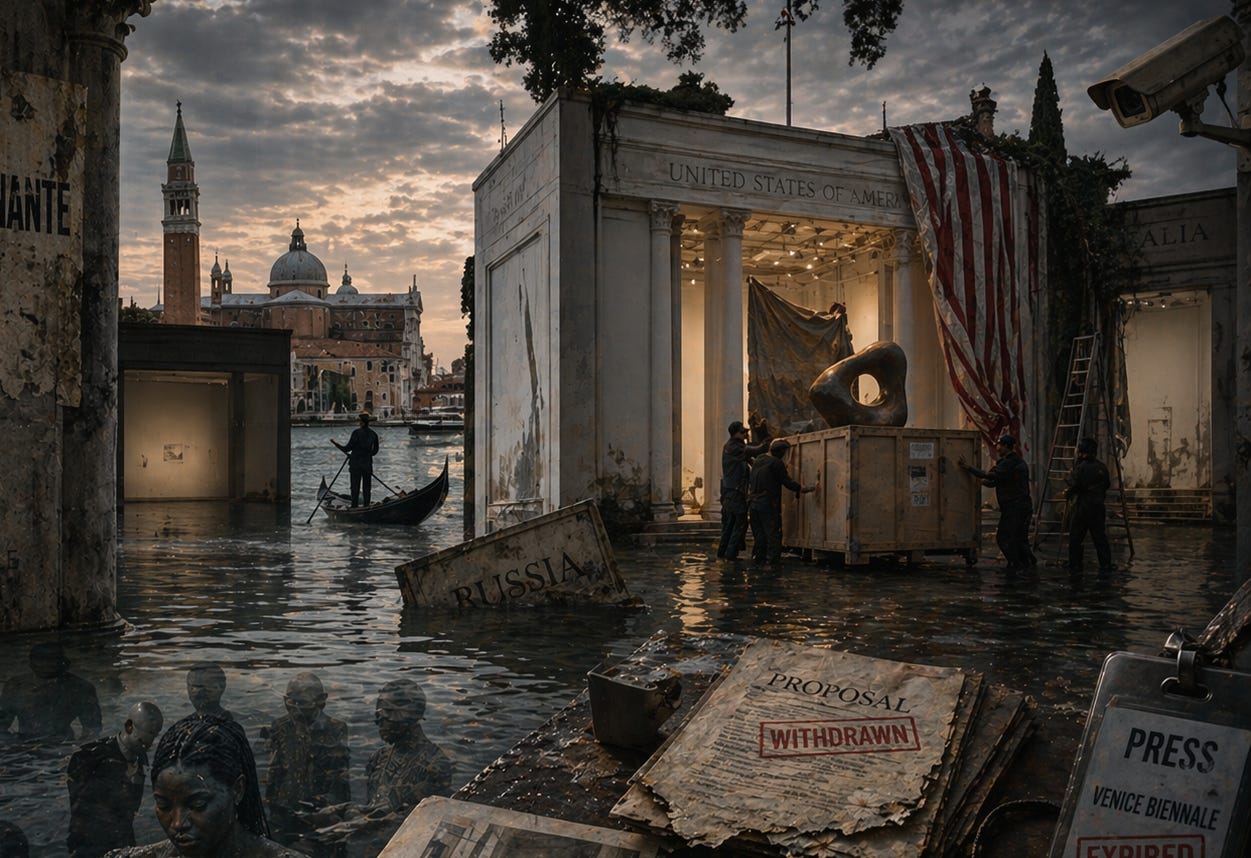
Venice opens May 9. The week it opens, almost everything that would normally govern it, the artist selection process, the press, the institutional frameworks, becomes visibly broken at once. I have been to the Biennale many times, as a director, as a dealer, as someone who builds and runs the machines. If you have never managed a location-specific multi-component installation across international customs, a city founded in the 5th century with no roads, and seventeen time zones, the logistics make any international art fair look like a bake sale. They also speak their own distinct dialect, Venetian, going strong since the medieval Republic. It is not Modern Italy. It is something older and mystical and more itself.
It is one of the great cities of the world, in deep contention with Florence, always, which is part of why this week has been difficult to sit with.
The American pavilion
Alma Allen, a Utah-born sculptor living in Mexico, will represent the United States at the 61st Venice Biennale in a show titled Call Me the Breeze. He is soft-spoken, self-taught, makes biomorphic sculptures in stone and bronze that critics have compared to Brancusi. None of what follows is really about him.
The original winner, New York sculptor Robert Lazzarini, was dropped after a funding agreement collapsed. Allen didn’t apply. He was approached directly by curator Jeffrey Uslip in October, bypassing the formal proposal process that has governed US pavilion selections for decades. His two galleries urged him not to accept. When he did, they cut ties with him. He is now represented by Perrotin, who is providing logistical support for the pavilion. The State Department described the show as furthering “the Trump Administration’s focus on showcasing American excellence.”
Allen will be the first white male to represent the United States in Venice since 2009. The four artists who preceded him:
2017 — Mark Bradford
2019 — Martin Puryear
2022 — Simone Leigh, who won the Golden Lion, the first Black woman to do so
2024 — Jeffrey Gibson, the first Indigenous artist to represent the US solo
The pavilion had become, over those years, a place where America was genuinely reckoning with itself on a world stage. Simone Leigh’s work was an extraordinary gift to witness in person. I was deeply proud to be American and working in contemporary art during that time. That pride is not something I feel casually, or perform easily. It was real.
I am not interested in prosecuting Allen. I am interested in what the sequence reveals about the system that produced it.
La Dominante
The US has participated in the Biennale every year since 1895. The national pavilion model, each country occupying its own permanent building in the Giardini, has always been as much about geopolitics as art. The pavilions are, in their bones, embassies. Flags in the garden. A country’s presence or absence, the artist it chooses, the framing it brings, all of it reads as a statement of national identity on a world stage.
This matters to you as a collector because the Biennale is where cultural value gets formally conferred. It is where artists become historically significant, where institutions signal what they believe deserves to last. If you have ever bought work because you believed in what it stood for, not just how it looked on a wall, then you already understand that art and power are not separate conversations.
It was Mussolini who expanded the Biennale into the institution we know today. The Giardini as we know it was substantially built under fascism, for fascism. Hitler visited in 1934, on his first state visit abroad. When the war came, the enemy pavilions, British, French, American, were occupied. Someone else decided what filled them, under what framing, in service of what story.
An empty room is never just an empty room. It is an invitation for someone else to decide what fills it.
This week, Russia returned to the Giardini. The European Commission has threatened to freeze two million euros in Biennale funding in response. Ukraine, actively at war with Russia, is also participating. Both countries are in the Giardini simultaneously, right now. That is the Biennale. The highest stage in the arena, and it has always been exactly this.
The day the music died
The same week Venice opens: Artnet and Artsy announced a merger under UK investment firm Beowolff Capital. The day after, dozens of staffers were laid off among them Sarah Cascone and Eileen Kinsella, both senior reporters at Artnet News with more than a decade of institutional memory between them. The merger press release mentioned AI tools for market data. Journalism, as a diagnosis, doesn’t sell.
Cascone and Kinsella are the kind of reporters who know where the bodies are buried who has relationships with which collectors, which galleries are actually solvent, what the real story is behind a pavilion selection. That knowledge doesn’t transfer. It just leaves.
This should concern you more than it might seem to. The trade press is not just background noise it is part of how value gets established, contested, and remembered. When experienced arts journalists are replaced by market data tools and AI summaries, the record gets thinner. The accountability disappears. The gap between what institutions say about themselves and what is actually true gets wider and harder to close.
What this week revealed
Here is what was also true before this week: Artnet’s media revenue was already in decline. The pay-to-play pavilion model was already operating inside the Giardini. Perrotin was already Perrotin. Allen’s galleries dropped him, both of them, independently, at the same moment. That unanimity is its own kind of statement.
What this week did was make it impossible to look away. The institutions that normally confer and contest cultural value, federal arts bodies, major galleries, trade press, are all compromised or contracting in the same window. Simultaneously, under applied pressure. There is no single villain. There is just a system revealing what it was always made of.
An industry that spent decades building institutions that looked like they were about culture, but were structurally about capital. When capital gets squeezed, the cultural scaffolding falls away. Because it was always thinner than it looked.
So where does that leave you, as someone who buys art, who believes in it, who has built a collection around the idea that it means something?
Value does not originate in institutions. It originates in the studio. It gets recognized in relationships between a dealer who knows the work deeply and a collector who trusts their eye. It gets sustained over time by people who chose deliberately, not because they were told to. The institutions ratify. They have always been slower, more political, and more compromised than the story they tell about themselves. What this week revealed is that the ratification machine is breaking down. That is not necessarily a loss.
Whatever was working before isn't working anymore for almost everyone. The people doing well are maintaining or absorbing others. Everyone else is fighting a losing battle. This structure stopped creating the conditions in which great art gets made. It once did. But with new tools, a new generation, and a new reality, it has to be remade. That is what Lion & Lamb is. A response to what this moment requires, a more deliberate room, a tighter and more transparent way of working, where the work is chosen carefully and the relationships are real.
La Dominante endures as it has for hundreds of years. So does the work that matters, regardless of which room it's in.
Thank you for reading,
Rachael
Thank you for this column. I like your insights and look forward to reading more of your work.
The Big A art world is suffering from self-inflicted wounds. They have become dull experts.
And now those "experts" are howling about a self-taught artist chosen by a self-taught curator - oh, the horror!
I don't care for the artist chosen; his work is too safe for my taste. I’m sorry an AI, 3D, or generative artist wasn’t chosen, it would have been more relevant to our age.
That said, I’m delighted to see self-taught artists being displayed. Why not put on an entire international show of self-taught artists? Come on art world, let's see some innovative leaps for a change.