
The White Room
At The Studio Table: On neutrality, reverence, and why comfort is a political act.

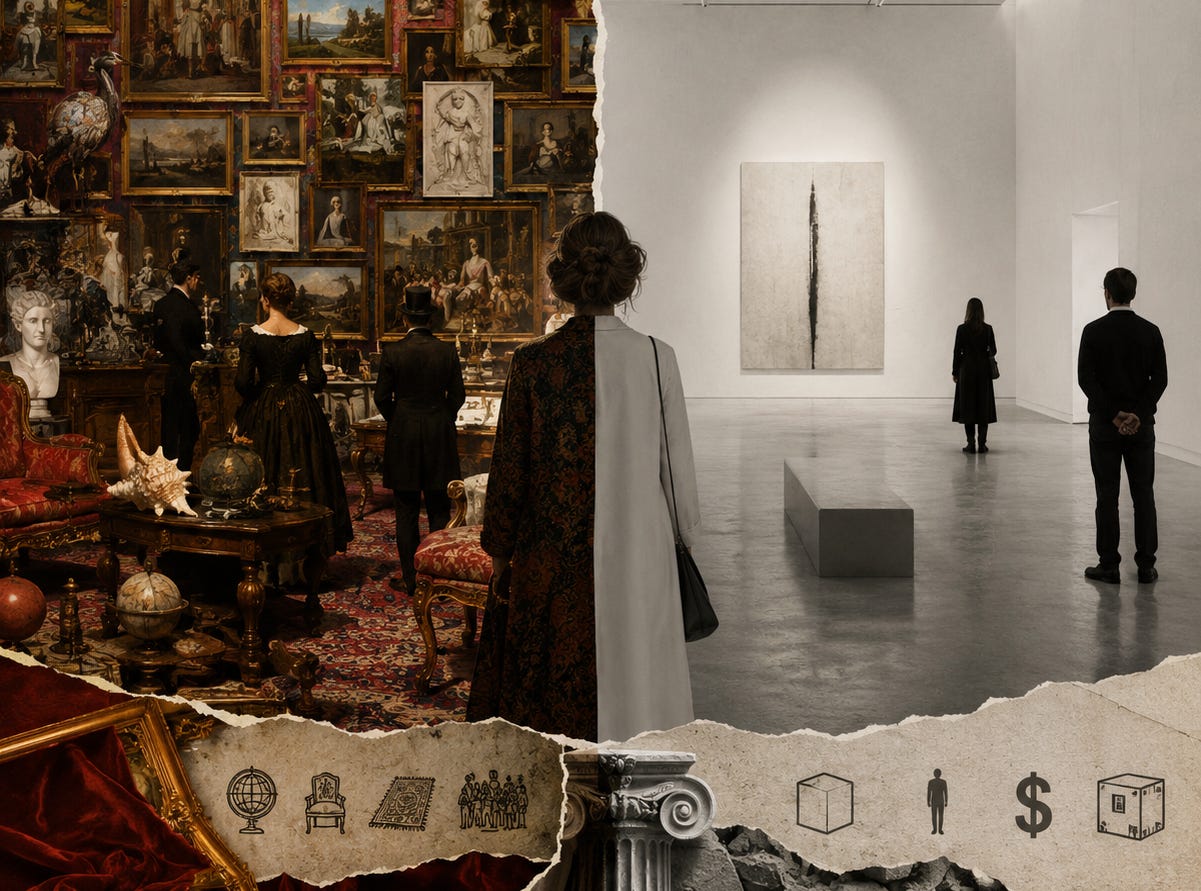
Walk into almost any modern contemporary art gallery in the world and you’ll encounter the same room: white walls, concrete floors, track lighting, nothing soft. The higher you go, the more prestigious the space, the more serious the program, the whiter and more expansive it becomes. As if emptiness were a credential.
Brian O’Doherty wrote the definitive essay on this in 1976. “Inside the White Cube” argued that the modern gallery evolved to strip context from the work entirely, no furniture, no color, no windows, no life. The idea was that a neutral space let the art speak for itself. That anything else was a distraction, or worse, an imposition of meaning.
Which sounds noble. It was also an ideology dressed up as architecture.
What’s easy to forget is how recently this happened, and how strange galleries looked before it did.
The earliest collecting spaces, the Wunderkammern, the Cabinets of Curiosity of the 16th and 17th centuries, weren’t about art at all. They were about accumulation as spectacle. Paintings hung alongside taxidermied animals, shells, scientific instruments, maps, and antiquities. The point wasn’t contemplation; it was the demonstration of range. How far you’d traveled, what you’d encountered, how much of the world you could possess and display simultaneously. Art was one category of remarkable thing among many.
By the 17th and 18th centuries, the salon-style hang had emerged from private picture galleries at European aristocratic estates. These were rooms lined floor-to-ceiling with paintings, hung symmetrically, framed in gold, on walls covered in deep-colored fabric, crimson velvet, damask, silk. There was furniture. There were rugs. The paintings coexisted with objects, with ornament, with the evidence of life being lived. The rooms had color and warmth because they were rooms.
The Paris Salon brought this format into public life, and it remained chaotic, competitive, alive. Works of every scale and subject jostled for position on the wall. Hierarchy existed, but it was spatial, the celebrated works centered, the landscapes and portraits relegated to the upper and lower registers, not environmental. Every work was visible and present. The hang itself was an argument.
When the National Gallery in London first opened in 1824, it wasn’t a museum as we’d recognize today. The paintings were housed in a banker’s townhouse in Pall Mall, with the same domestic salon hang used in private homes. The first public galleries were literally repurposed interiors.
The transition to white walls wasn’t even a manifesto. Here’s the detail that keeps nagging at me: in post-war Germany, the white wall and single-row hanging became standard largely as an emergency measure after the cessation of hostilities, bare plaster because there was nothing to cover it with, stripped of ornament by necessity. That aesthetic got naturalized. Dressed up as philosophy. Exported as the language of serious art worldwide.
The white cube was never neutral. It was a very specific aesthetic and power statement: art is separate from life. Elevated above it. It requires a special pilgrimage to encounter, and the encounter should feel like something, like gravity, like consequence. The gallery achieved this through a particular kind of discomfort. Hard floors, cool air, the suggestion that speaking too loudly might constitute a violation. Reverence manufactured through unease.
It also suited the market at the time perfectly, which is maybe not a coincidence.
A white cube is a showroom. The work is isolated, easy to see, easy to imagine on your own wall. The furniture, the warmth, the conversation, those slow everything down. They generate attachment to the room rather than the object. The white cube speeds the transaction up by removing everything that isn’t the transaction.
But there’s something more specific happening than efficiency. The white cube also removes the risk from the sale. An isolated work on a white wall tells you exactly what you’re buying, its scale, its surface, its relationship to nothing but itself. A work in a room with furniture, warmth, other objects exists in relationship, and relationship is harder to own. The white cube sells the fantasy of the autonomous object. Which is also, not coincidentally, the fantasy of the investment-grade asset. Clean. Transferable. Unencumbered by context.
And then it became the default, because galleries copied galleries copied galleries until everyone forgot it was a choice.
The artists the white cube was actually built for, the abstract expressionists, the minimalists, often genuinely needed that kind of space. Scale, spatial relationships, the way light moved across a surface. The emptiness was functional. But the format got applied to everything regardless of whether it served the work, and eventually it just became what a gallery looked like. A grammar everyone used without thinking about what it was saying.
Here’s what it’s saying: access should be hard. Difficulty is proof of value. Comfort is suspicious. That’s not an art argument, that’s a class argument.
The white cube keeps the room feeling exclusive by making everyone in it slightly anxious, and not everyone equally. The person who grew up in galleries, who knows the codes, who has the ease of long familiarity, they move through that space without friction. The person just arriving, the aspirational collector still learning the language, the first-time visitor who isn’t sure whether they’re allowed to ask the price out loud: that person gets crushed by it. Not turned away. Just made to feel like they’ve missed something they can’t quite name.
And here is the telling irony: the truly wealthy collector doesn’t need the white cube to feel validated. They’re already comfortable. The couch does not threaten them. It’s everyone else who pays for the performance of rigor, the person who came wanting to love something and left feeling like they didn’t know enough to.
This is the opposite of what the salon actually was.
The salonnière wasn’t trying to make people reverent. She was trying to make them sharp. A good salon required that people be present, engaged, comfortable enough to argue, with the art, with each other, with the ideas in the room. That’s not the same as casual. It’s demanding in a different way. It asks something more than silence and deference.
You can’t have a real conversation standing on a concrete floor under track lighting wondering if you’re allowed to touch anything. The atmosphere of the white cube works against the kind of thinking it’s supposedly designed to inspire.
I have a couch in my gallery, a whole curated sitting room, actually.
I didn’t put it there as a statement. I put it there because I want people to sit down, stay long enough to actually look at something, feel like they belong in the room. People keep remarking on it, like it’s unexpected, even a little transgressive. Comfort apparently is a choice that requires explanation.
It does, I suppose. It’s just not the radical choice. The radical choice was the one that came before it, the decision, made decades ago in service of a particular market and a particular ideology, that the art world would present itself as uncomfortable by default.
And my thinking isn’t new thinking. Isabella Stewart Gardner knew it, her Boston palazzo was installed exactly as she lived in it, art among furniture among flowers among light, and her will stipulates it can never be changed. Peggy Guggenheim knew it, showing Calders and Ernsts in her Venice home, where the work existed inside a life rather than above one. The salonnières knew it centuries before either of them. The white cube seems to have made us forget, made forgetting feel like sophistication.
That decision got naturalized and now a couch is an act of defiance.
But really it’s just an act of recovery. A reaching back toward something that was always true: that art belongs inside life, not cordoned off from one. That the room should feel like somewhere you’re allowed to be, where you want to be.
Which tells you everything you need to know about what the white cube was actually doing all along.
Thank you for reading. I am gallivanting between fairs this week, what another writer coined, to my great delight, a luxury-sponsored psychological endurance ritual. Which it is, especially if you’re working it. I am, to my great pleasure, not in a booth this year likely the last time I’ll have the luxury of mingling more casually for some time. As a result, I hope to see you out in the city. And if you spot me, please do stop and say hello. You can’t miss me, I promise.
-Rachael
I understand that one mustn’t accept the white cube just because, but going from the rug-covered walls of the nineteen century to post-Germany (and linking the white cube to the post-war destruction) erases the precise and quite mysterious moment when the white cube started forming, a history that is fascinating because it is a slow often anonymous and collective determination against the wealth superimposing itself onto the image (ornamented frame vs the painting), but also against excess of information and the impracticality of ornament (see Adolf Loos in Vienna and many others) in Glasgow, in some places in Germany but also Paris at the end of the 19th century and beginning of the 20th. In fact, when the Nazis came to power, a sort of transversally, if occasional plainness that also happened in Russia, for example, had been established already, in order to focus on the art. Coming from a time where the bourgeoisie was associated with abundance of decor and objects (see Walter Benjamin and his hatred of the family silver cutlery and precious objects), art, to be SEEN, had to appear in a single line on a monochrome wall. Whether the latter was yellow or light grey, it doesn’t really matter. What matters is that, if you look at the Klimt exhibition room in the Venice Biennale in 1910, it is a plain old white cube, and not the only instance where this happened.
I get wanting to re-establish a sense of domesticity and proximity with art, but the white cube, whether we like it or not, is very much associated with a reverence of the image, which, like any rule, became quite dogmatic, at a certain point, but is far from being untouchable nowadays. Now, the “minimal” style as it is understood nowadays is the new “rug on the wall”, the new way of show wealth because it requires space and an interior design hiding functional objects. It’s interesting how wealth always tries to take over. Funnily enough the first shows that had those artists who “needed” the white cube often had benches, armchairs or even a couch, which is now seen as bad taste by many, I don’t know why. However, I hope we don’t go back full circle and start coordinating paintings to couches and rugs to sculptures in colour coordination schemes! In some ways art has to be separated from life so that we can experience it in a museum which is where art belongs to all - at least in public collections. You’re not going to read a book in a nightclub. I’m all for a plain house with good couches, nice books and great art, like O’Keefe’s in the desert or Motherwell’s…
Loved this one Rachel, I’m all for some more comfort and life in galleries!