
Withheld Resolution
At The Studio Table | Why Collectors Can't Stop Looking at These Paintings

with Rachael Lambert
There is a painting type circulating right now that I keep stopping at and so, it seems, does everyone else. Not because it asks something of me, but because it already knows something about me. The face caught mid-scream that reads more like a laugh. The figure blurred at the edges, as if glimpsed through a window or across time. The woman who is not quite crying but is not quite fine. A feeling of deep-saturated tobacco, old library pages, stained linen, something aged and interior, threaded through paintings currently appearing everywhere.
I am drawn to it because I identify with the lonely girl. Not the wounded one. There is a difference, and these paintings seem to understand it instinctively. And increasingly, it is apparent that many other people notice too.
Art trends for reasons. It always does, even when we tell ourselves we discovered something privately, through our own eye, on our own terms. The algorithm did not invent your longing for this work. It recognized it.
So then what is the emotional weather right now?
Withheld resolution.
We are living in the aftermath of a particular kind of disappointment, not catastrophe, which at least has the dignity of scale, but something quieter and harder to name. The slow discovery that institutions we believed in were more fragile than they appeared. That communities we invested in were more transactional than they felt. That people we wanted to build something real with were operating from a different set of assumptions about what real meant. That systems and dreams and ideas we were promised, if executed diligently, would pan out. This is not trauma in the clinical sense. It is something closer to naivety grieved a particular ache of having been open, and finding out that openness was not shared.
You can watch this feeling move across an entire spectrum of current painting. It looks different at every temperature but it is the same feeling underneath all of it. I have been watching it form since around 2020, though few people were paying attention then.

2020 Anna Weyant, oil on canvas
The seeds were there in Anna Weyant’s earliest work, solitary figures in domestic spaces that felt simultaneously familiar and slightly wrong, painted from what she described as private necessity, not cultural calculation. The work existed before the audience was ready for it. What happened between 2022 and now is not that the artists changed. It is that the culture finally caught up. The emotional weather arrived, and suddenly the work had a receiver.
This matters enormously if you are a collector trying to understand what you are looking at. The artists driving this wave were not trend-chasing. They were working from interior feeling that the rest of us would arrive at two or three years later. That gap, between when the artist feels something and when the world becomes fluent in it, is where the most important collecting happens. By the time a feeling has a name and a magazine profile, you are usually buying a diluted echo rather than the source.
What you are seeing now, across painters who have never met and work in entirely different registers, is a spectrum of the same unresolved feeling at different temperatures.
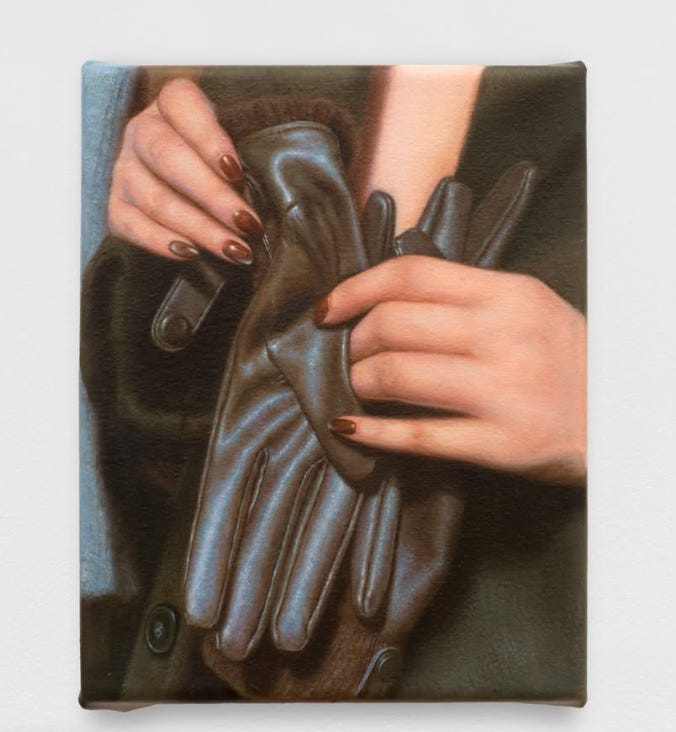
2026 Jesse Zuo - Bordeaux, oil on canvas, 10 x 8 in - With Plato Gallery
At one end: melancholy displaced into objects. The sleeping woman against her gifts. The pearl bracelet with its price tag. The leather gloves gripped. Emotion held in things because the figure cannot say it directly.
This is also where the wave’s most derivative expression lives. The atmospheric blur, the withheld figure, the mood-as-subject, when these become the signature rather than the vehicle, you begin to see painters working fluently in the frequency without necessarily generating new problems within it. Jesse Zuo is talented and the work is genuinely felt, but it sits closer to Weyant’s emotional register than to its own formal argument. Which makes it a useful bridge, between the contained psychological pressure of Weyant’s domestic interiors and the full atmospheric dissolution at the spectrum’s other end, and a useful diagnostic. When a feeling becomes a style, you can feel the difference. The image stops asking and starts confirming.
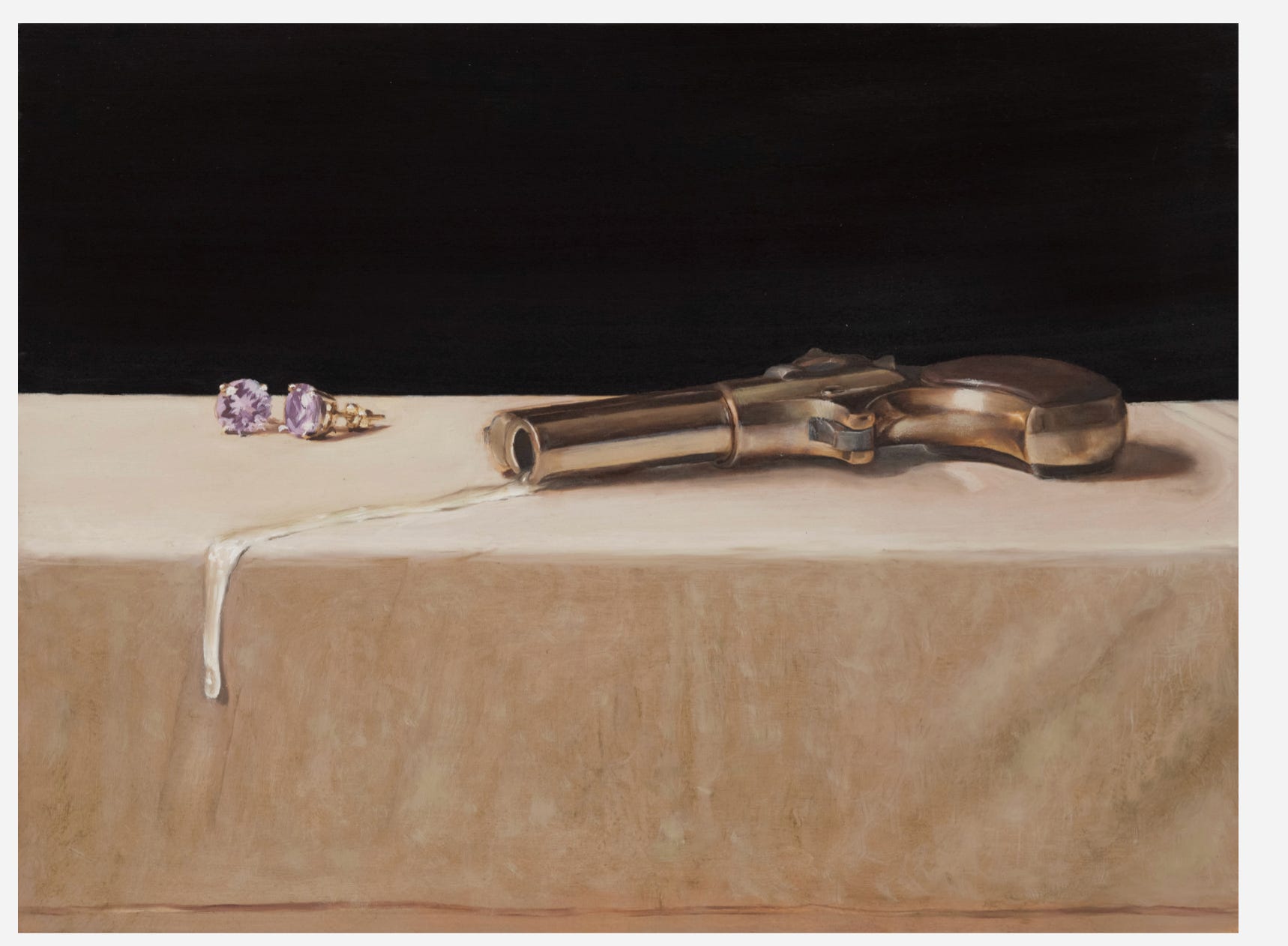
2026 David Smalling - Fast and Loose, oil on panel, 12 x 16 inches
In the middle register the body appears, but under pressure. David Smalling, whose recent exhibition Elizabethan Collar at Templon New York uses the Dutch Golden Age and Vanitas tradition to examine something far more specific and far more cutting: what happens after access. After the degree, after the room, after entry into the aspirational space has been granted but before true agency materializes. His paintings arrange pearls, lipstick, ribbons, brass instruments swollen and deformed by internal pressure, a snail leaving its slow trace across an otherwise pristine composition. The cone of shame, a veterinary device designed to prevent an animal from tearing at its own wounds, becomes his central metaphor for conditional belonging. You are in. You are protected. You cannot move freely.
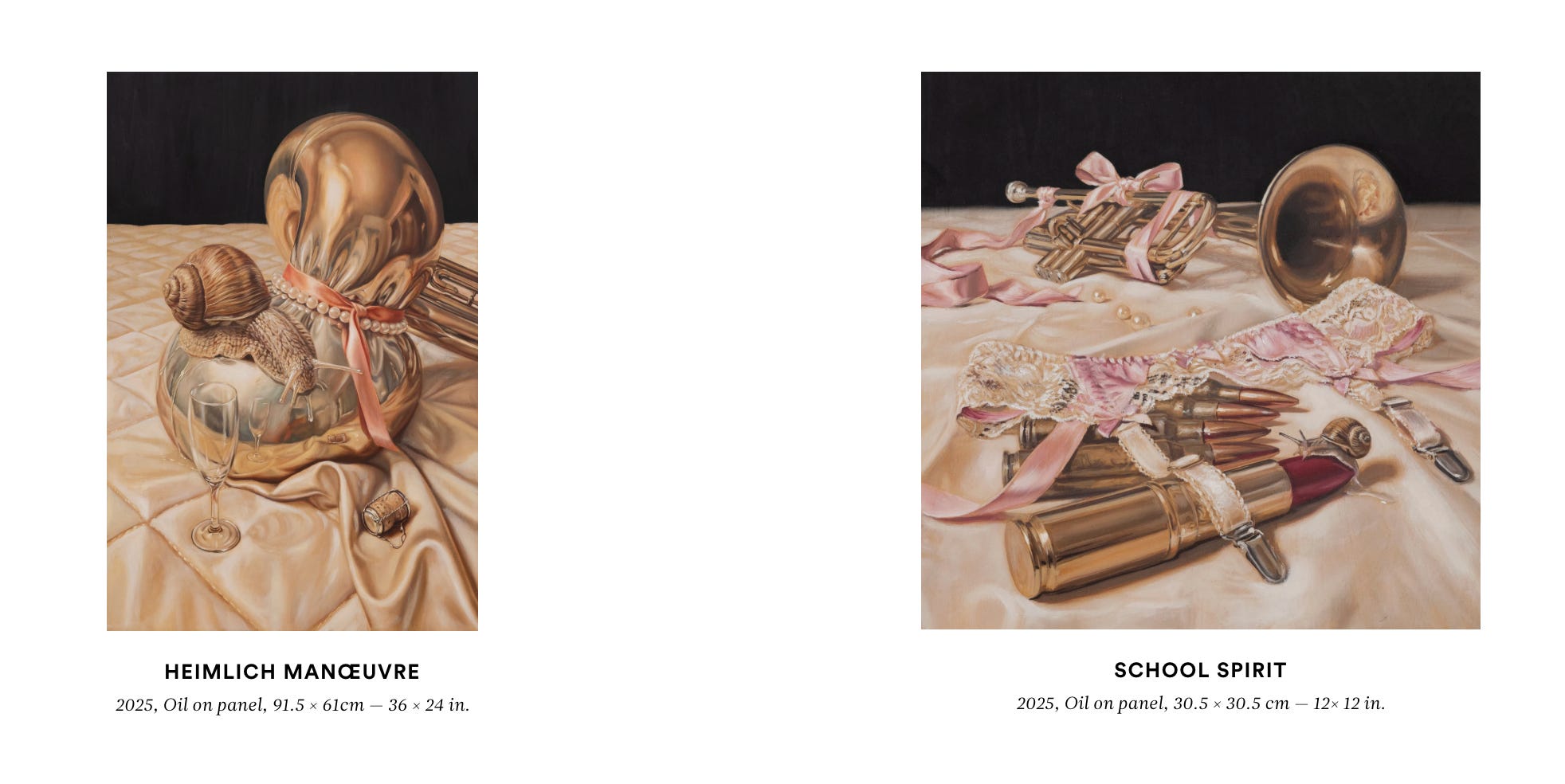
This is not the same wound as Weyant’s. It arrives from an entirely different cultural experience, a different body, a different set of inherited expectations. And yet it is the same frequency. The withheld resolution. The entry granted, the agency withheld. The face you make when you understand that the room you worked your whole life to get into was designed for someone else’s comfort, not yours.
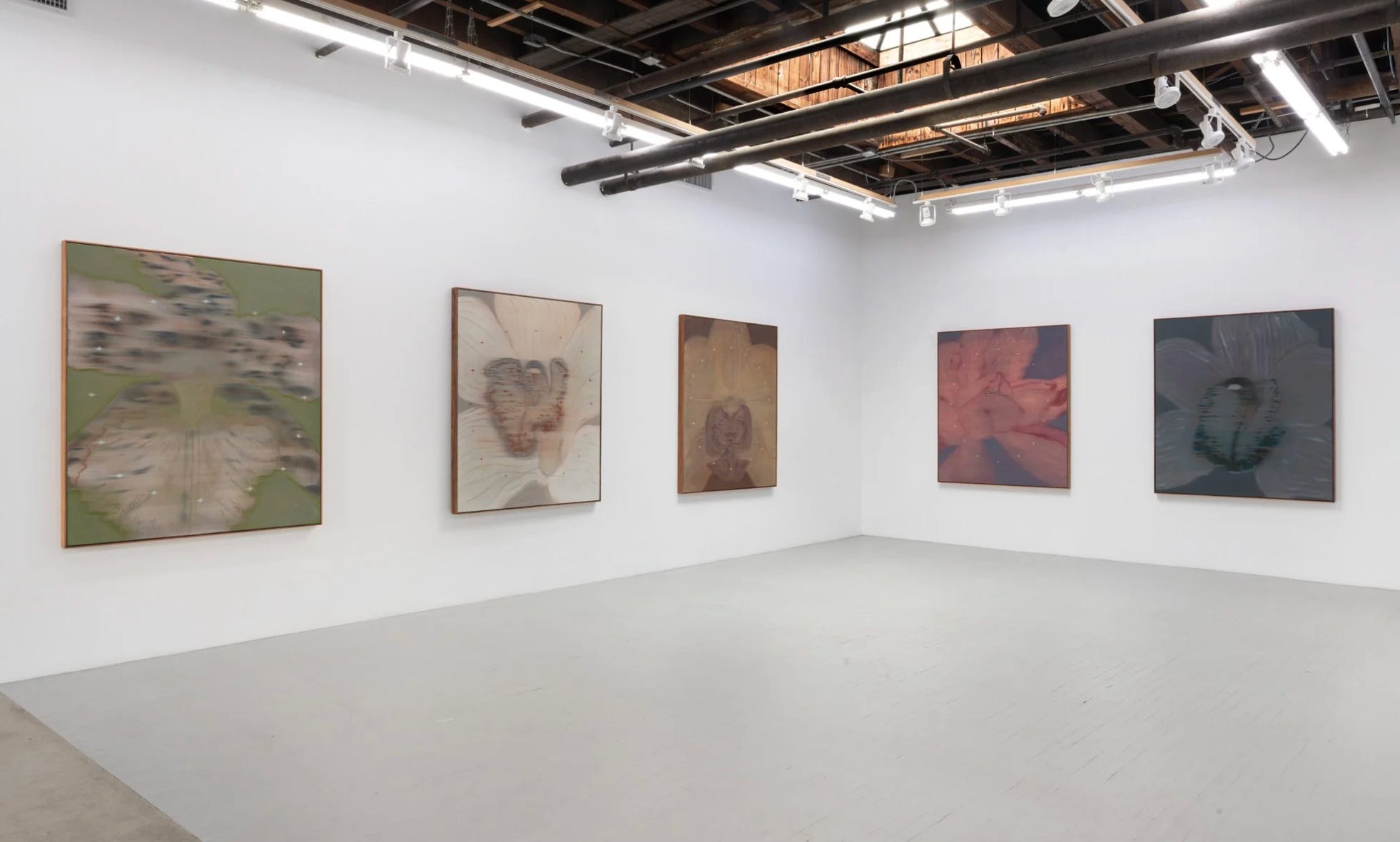
2026 Heath Wae- Mineral Meridian Exhibition with Carvalho
At the furthest end, the figures dissolves entirely into atmosphere, botanicals that pulse with erotic and elemental energy, landscapes and people blurred as if seen from a moving car. Pure feeling, no anchor.
What connects all of it, the sleeping woman, the cone of shame, the vanishing subject , is that every single one of these paintings refuses to complete the emotional sentence. They hold the suspended moment. The threshold. The held breath before you know what happened or what comes next.
That multiple artists working formally and culturally apart are making work that emits at the same frequency is not a coincidence. And there is something else worth naming, even if it sits uncomfortably on the page.
The majority of painters in this wave are women, or are centering women as subject. That is not a coincidence and it is not simply a matter of aesthetic preference.
There is a specifically female experience of withheld resolution that this work holds, the experience of having been told that if you followed the rules, kept yourself together, stayed open, stayed generous, stayed present, the room would eventually become yours. And then discovering that the room was never designed with your full occupancy in mind. Not through overt hostility, which at least has the clarity of an enemy, but through something quieter and more disorienting. The assumption built into the architecture that you were a guest, however welcome, however decorated, however accomplished.
Smalling’s work arrives at this from a different direction, conditional belonging across race and class rather than gender, and lands in exactly the same frequency. Which suggests the feeling is not gendered at its root. It is the feeling of anyone who earned entry into a system that was not built to fully receive them.
But the fact that so many women are making this work and buying this work right now, in this particular moment, when the ground under bodily autonomy has been explicitly and legally rearranged that is not background noise. The withheld resolution is not abstract for them. It is current and it is personal and these paintings are one of the few places it is being held with honesty and without resolution forced upon it.
That is a profound thing for art to do.
So the question every collector should ask themselves is not whether they are drawn to this work. Clearly they are. The question is whether what they are drawn to is the feeling or the painter.
Because the feeling will pass. Feelings always do. The emotional weather shifts, the culture finds a new frequency, and the work that was once a mirror becomes a period piece. Every era produces painters who are fluent in the feeling of the moment, and most of them do not survive the moment’s passing. What survives is structural intelligence. The thing underneath the mood.
Look again at the work you have been stopping at. Ask yourself: if I removed the emotional context I brought to this would this painting still move me? Is there a formal problem being solved here, or is the painting simply giving me back what I already feel? Is this a mirror or is this a portal?
This is the distinction that separates Weyant’s best work from her weakest. Her strongest paintings are technically audacious in ways that have nothing to do with trend, the specific quality of light in a darkened room, the way a figure’s posture contains an entire psychology, the compositional tension that makes a still life feel like an interrupted sentence. Those things will still be true in thirty years. The melancholy is the vehicle. The painting is the destination.
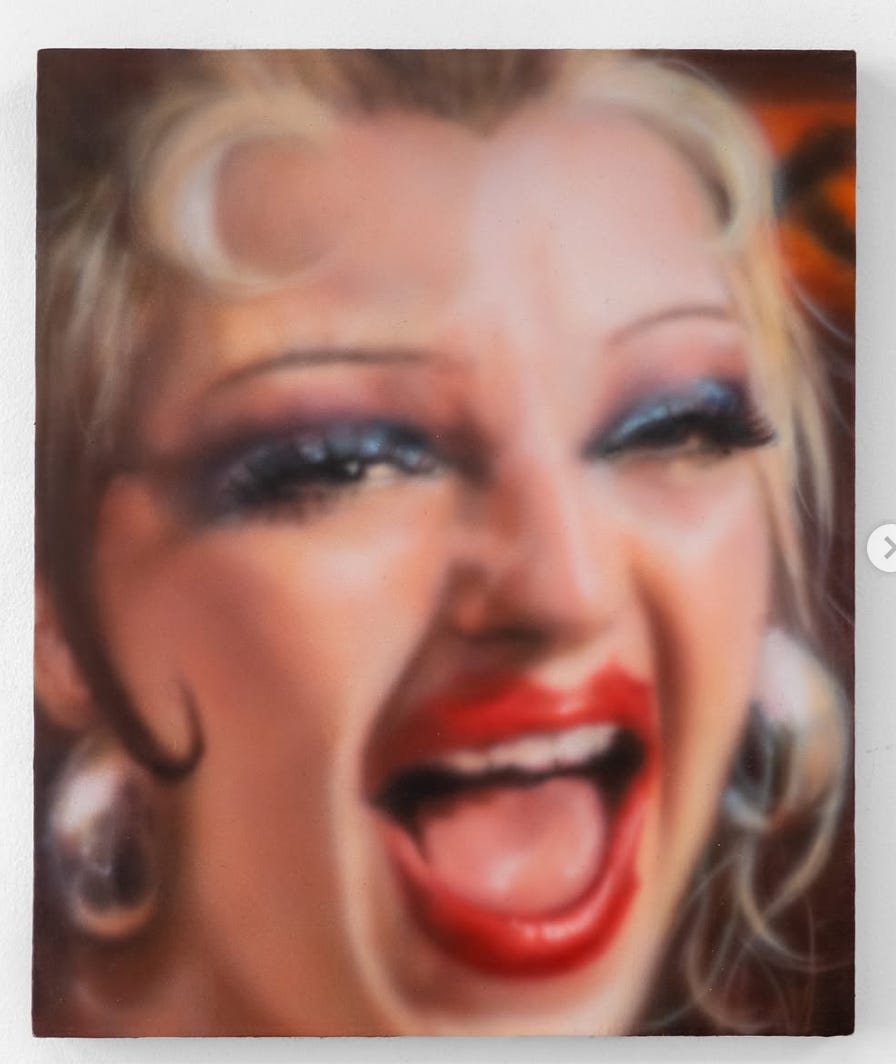
2025 Liza Jo Eilers - pickmeupmadonna, acrylic on linen 457 x 381 cm
Liza Jo Eilers is doing something more dangerous and more interesting, working at the edge of legibility, where the image is almost consumed by its own references and interventions. The censored passages and layered imagery are not decoration, they are the argument. But she will need to deepen that argument as the cultural moment fades. The painters who keep asking harder questions of themselves after the world stops asking easy questions of them are the ones worth following.
The painters at the atmospheric end of the spectrum, which there are many right now, have a different but equally real risk. Pure atmosphere can become purely decorative. Richness without resistance tends toward wallpaper eventually. What you want to see is whether the conceptual frame continues to generate new problems or whether it becomes a signature applied on repeat.
Here is what I would tell any collector standing in front of this work right now, feeling that pull of recognition: trust the feeling as a guide toward the work, but do not trust it as a reason to buy. The feeling tells you where to look. The looking has to do the rest of the work.
Stand in front of it longer than is comfortable. Ask whether it is giving you something or just confirming something. Ask whether it needs you to be living in 2026 to work or whether it would stop you cold in 2045, in front of someone who knew nothing of this moment and felt none of this weather.
The work that answers that second question are the ones worth owning. And there are more of them in this wave than any cynical reading of the market would suggest. The feeling that summoned them is real. Some of the artists feeling it are genuinely extraordinary.
Your job as a serious collector is to know the difference.
That is what I am here to help you figure out. Not to hand you easier answers but to sit with you in the uncertainty and help you ask better questions. That is what I have been doing, after many years and many conversations.
We will deep dive into that in an upcoming essay. what I built, and why, and what I believe every collector deserves access to regardless of where they are in the practice.
In the meantime: go look at something that stops you. Stay longer than is comfortable. Notice what the discomfort is made of.
That is where it starts.
Thank you for reading,
-Rachael